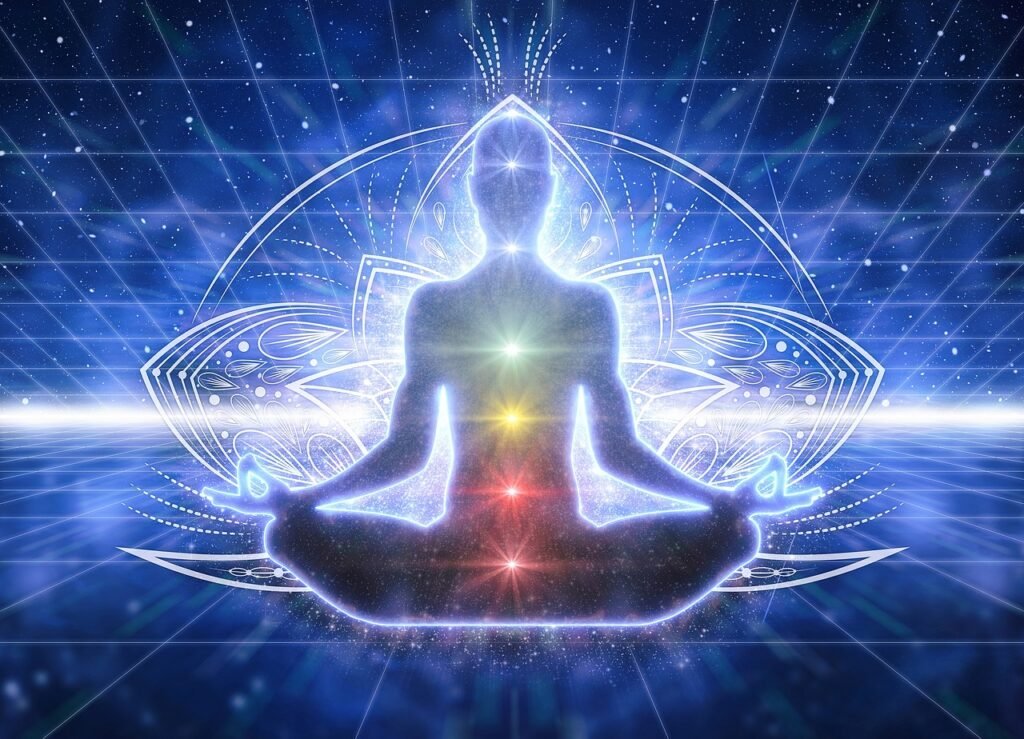
Interesting article on the divine feminine. A Vedic perspective
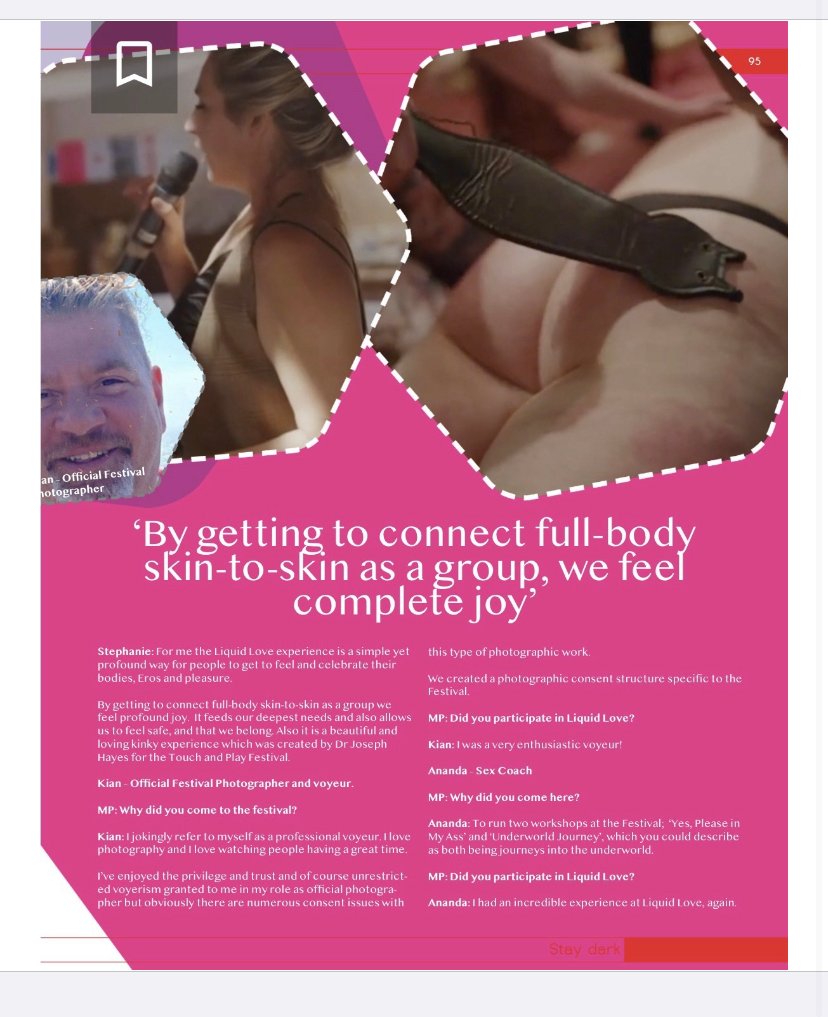
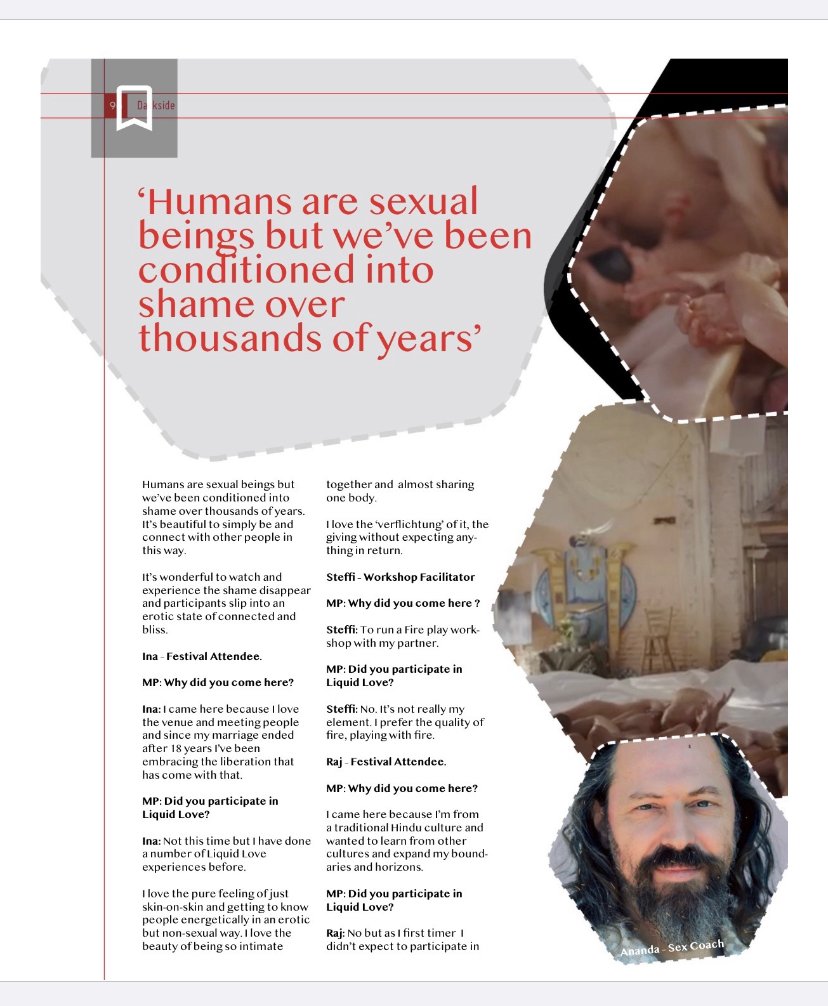
An interview I conducted at Taboo Festival 2024
I recently ran workshops at a kinky shadow work festival in Berlin that was staffed by sexuality practitioners and experts from across the globe.
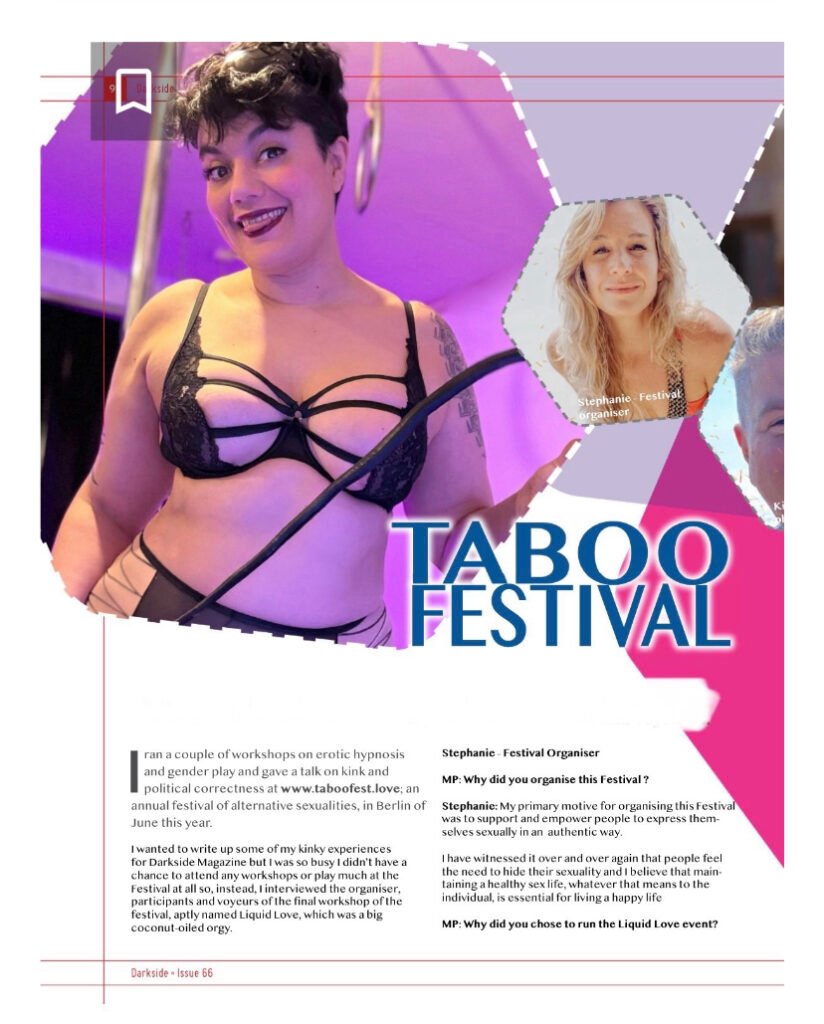
I wrote an article about the last workshop of the festival- liquid love ❤️

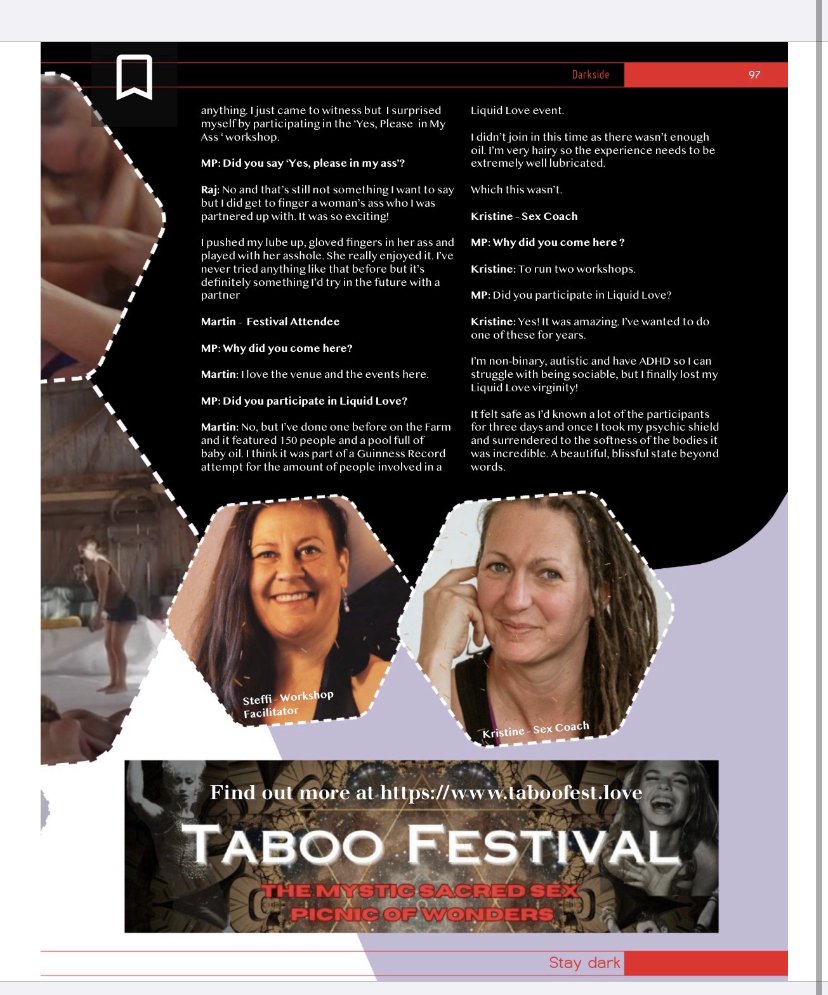


Kali Ma and tantra…. A tale of liberation from India’s colonial history
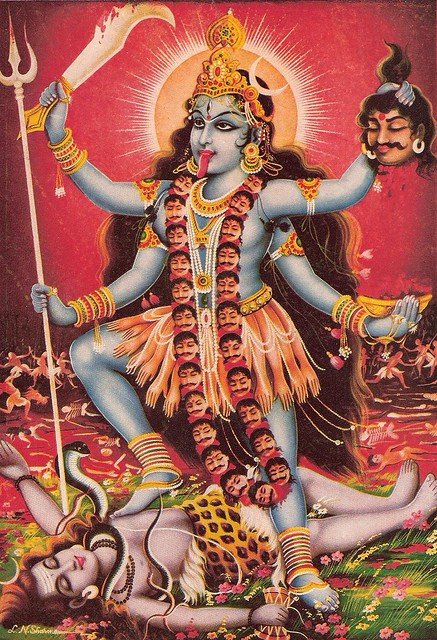
Much like practices like BDSM ma kali is often misunderstood. She is a path to liberation and freedom. Much like BDSM and dark tantra when practiced consciously
Liberate yourself from the restraints of “civilisation” and indulge in the repressed identity that is your true essence as a sexual being.
The term “tantra” derives from the Sanskrit verbal root “tan” (meaning “to weave”); in Hinduism, “tantra” refers to the dialogue between god and goddess. Tantric texts usually take the form of a dialogue between Shiva and Shakti. The holy couple
Kali is one of the many forms of Shakti, According to traditions dating back to pre-Vedic times, Kali was born from the third eye of Goddess Durga as a destructive and terrifying but ultimately liberating manifestation of female power
Throughout India to this day, Kali is revered as the destroyer of evils, able to free her devotees from unjust rule and submission.
Kali has many forms, such as that of a mother and a warrior. She became a symbol of revolution in the 19th century Bengal.
Kali means resistance. In this case resistance was against white supremacy.
In the East India, Bengal was the epicentre of British colonial rule from 1757, as well as
one of the earliest places of tantric practice. Kali embodied the cosmic connectedness of creation and destruction. Since the beginning of the 19th century, British missionaries and imperialists in India have fantasized about tantra, and in particular the Kali cult, as a corrupt cult of violence and ecstasy that justified its civilised presence.
Indians took advantage of this, using the idea of kali to express their anti- colonial sentiments. The widow goddess Dhumavati was employed as a sad representation of India as a “beggar mother” (Bharat Bhiksha), toothless and emaciated, devastated by the periodic famines inflicted on the nation by British economic policies.
This was one of the many visual means undertaken to reimagine the motherland.
In 1907, the advertisement for Swadeshi ‘Kali Cigarettes’, published by Calcutta Arts Studio caused further unease in the Britain.
Herbert Hope Risley was particularly anxious that Kali appeared to be adorned with European heads, and it was such imagery that prompted him to draft the Press Act of 1910, threatening eruptions of tantric terrorism.
Guided by the political theology of Bengali thinker Aurobindo Ghose (1872–1950), many organized underground secret societies posing as revolutionary sanyasis and performing esoteric initiation rites before Kali idols at cremation grounds while vowing to risk their lives for the homeland liberation.
Revolutionary pamphlets legitimized violence in the general public. It conjured up the bloodthirsty appetites of Ma Kali and her desire to sacrifice “white goats”, a coded reference to the English.
While guns were hard to come by, explosives were made from scratch, “Ma Kali Bomb” (Mother Kali Bomb) was devised
to literally destroy oppressive British rule.
The image of Kali standing on Shiva was used as the cover of James Campbell Ker’s Political Trouble in India, 1907-1917, a confidential account of the rise of the revolutionary movement.
Liberate yourself from the restraints of “civilisation” and indulge in the repressed identity that is your true essence as a sexual being.
Book a dark tantra session today 💗

The spicy psychology lectures
https://www.darksidemagazine.com/event-details/the-spicy-psychology-lectures
Yantra meditation
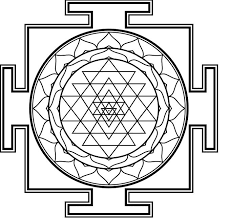

Representations of the yantra in India have been considered to date back to 11,000–10,000 BCE.
They are used to aid meditation; and for the benefits believed given by their occult powers based on hindu astrology and tantric texts.
As an aid to meditation (meditative painting), yantras represent the deity that is the object of meditation. These yantras emanate from the central point, the bindu.
A yantra typically has several geometric shapes radiating concentrically from the center, including triangles, circles, hexagons, octagons, and symbolic lotus petals. The outside often includes a square representing the four cardinal directions, with doors to each.

THE LOTUS (Padma)
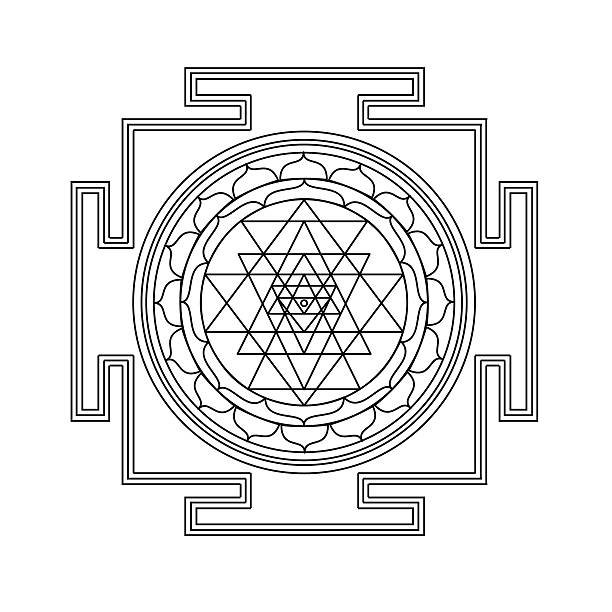
The lotus symbol (or its petals) is both a symbol of purity and variety. Every lotus petal represents a distinct aspect. The inclusion of a lotus in a YANTRA represents freedom from the multiple interferences of exterior (purity) and expresses the absolute force of the Supreme Self.
In conclusion, a YANTRA is a very complex spiritual instrument in one’s tantric practice ( SADHANA ). It can calm and focus the activities of the mind, and through its positive auto-suggestion it has a beneficial impact on the health and psychic well being of a person.
the secret key to using YANTRAS in meditation is RESONANCE. The process of RESONANCE is established by mental focus on the image of the YANTRA.
As long as the mind is tuned into the specific mood associated to that YANTRA, the energy flows, but when the RESONANCE is stopped, the energy disappears.
INSTRUCTIONS FOR MEDITATING WITH A YANTRA
Breathe in through the nose and out through the mouth, but do not force yourself at all, just let the breath flow normally.
Look into the center of the YANTRA, blinking as rarely as possible; you don’t want to look at the particular details of the YANTRA, just keep your eyes focused in the center and observe the whole YANTRA at once.
This exercise should last at least 15-30 minutes every day; the experience will be indescribable.
In time, after at least seven days of YANTRA meditation you will be able to tap into the same yantric energy even without a YANTRA (at the beginning you may fix your sight on an exterior or imaginary point or evoke the YANTRA with your eyes closed).
You should not pursue any specific objective when doing YANTRA meditation, just let it gradually guide you towards the sublime energies of the macro cosmos.
When executing this technique it is recommended that you maintain a state of aspiration and intense longing in order to experience the beatific energies of the divine consciousness.
In superior phases the YANTRA absorbs the practitioner’s complete attention, and he can no longer tell if the YANTRA is within himself or if he is within the YANTRA; this is the state of non-duality.
Ensure you dedicate your practice to a higher power

Tantric massage and PE issues
Premature ejaculation (also known as PE) is when a man ejaculates quicker than he, or his partner, would like to, often leading to feelings of dissatisfaction. PE can be primary, meaning it occurred at the first sexual activity, and went on to persist throughout a person’s life. Secondary PE can be developed at any point of a man’s life, and occurs after having had normal ejaculatory function. Premature ejaculation is very common, and is thought to affect up to 1 in 3 men at some point of their lives, although estimates vary.
Causes of Premature Ejaculation
The causes of premature ejaculation can vary, and can be physical, psychological, or a combination of both.


Physical
It is thought that low levels of the neurotransmitter serotonin may play a role in PE. Low testosterone or a hormonal imbalance may also contribute to, or cause, PE. Taking medications may help to correct these physical imbalances in the body.

Psychological
Psychological causes vary widely. These include worrying about body image or performance, previous negative sexual experiences or even sexual abuse and issues within an existing relationship. Cultural beliefs around sexuality are also often negative, and can lead to feelings of shame and guilt around sexual experiences. These can be so strong as to limit the amount of pleasure that can be experienced, leading to PE.

Combination
Erectile dysfunction (also known as ED)can also sometimes be a contributing factor, as men who find it difficult to get, or maintain, an erection sometimes develop PE too. As ED can also have either physical or psychological causes, it is a good idea to address these too.
Watching too much porn is often a major factor in this issue. Especially for younger men


How Tantric Therapy can Help
Tantric therapy sessions can help address PE in two main ways. The first is addressing any underlying psychological causes. The second is learning and practicing specific techniques that can help delay ejaculation. PE is common, and I work with many clients on this issue. My clients are often surprised to realise that they are able to not ejaculate for much longer than they are accustomed to.
Relax
One simple way to help with PE is to slow down and take more time to relax the body. Combining this with breathing more deeply can greatly increase the amount of time before ejaculation occurs. Relaxation and deep breathing can also help to open the body to feeling more pleasure, making it easier for sexual energy to spread from the genital area to other parts, and therefore reducing the urge to ejaculate.
Change Habits
Many men have simply gotten into the habit of masturbating quickly. During the lingam massage, clients are able to learn new masturbation techniques, as well as ways of slowing down and taking more time over self-pleasuring. This can both lead to a more fulfilling masturbation experience, as well as helping to last longer when being intimate with a partner.
Learn New Techniques
There are numerous different techniques that can be learnt and practiced that may help with PE. The extent to which they help can vary from person to person, and it is worth trying a variety to see what works for you. Breathing techniques, pelvic floor exercises, semen retention techniques and becoming more aware of the arousal rate through practicing the stop-start method are some ways to manage PE. As this can often be a sensitive subject, leading to much anxiety, learning good communication skills for talking about this with prospective, and existing, partners can also be beneficial in reducing the amount of stress and the pressure to ‘perform’.
Address Anxiety
PE can sometimes be caused by body image issues or anxiety about sex. These issues can be addressed in sessions, taking time to identify underlying beliefs and looking at ways of dealing with, or changing them. This can enable for more positive sexual experiences to occur. Performance anxiety can also be addressed by learning new tips and skills for improving love-making, and creating a safer space for intimacy to take place.
An article I found online…..
https://mashable.com/article/masturbation-meditation-orgasmic-mindful-sex
Tantric Techniques;
Tantric Breathing
Tantric breathing is a breathing pattern that involves deep breathing to create sensations in the sex organs. It’s often used in tantric sex, which is a meditative practice that involves exploring sensations in the moment.
The goal with tantric breathing is to breathe deep enough to start to feel sensation in your sex organs. Movement. Lay flat on your back and let go of tension. As you breathe, arch your back and lift up your pelvis.
Steps
- Inhale deeply into your abdomen
- Inhale deeply into your chest and lungs
- Inhale deeply into your clavicles
- Exhale deeply to empty your lungs
- Lie on your back and arching your back as you breathe and feel the energy move in and out of your genital area with your in and out breaths
- You can try taking things slow and staying open to what feels good
kapalabhati breath
A type of tantric breath that involves forcing out your exhalations.
Kapalabhati, also known as the “pumping breath” or “shining skull” breath, is a yoga breathing exercise that involves rapid exhalations. It’s said to improve breathing, lung function, and cardiovascular health.
How to do Kapalabhati
- Inhale fully
- Exhale quickly and sharply through the nose
- Inhale again fully and hold your breath for a few counts
- Exhale completely and return to normal breathing
Benefits
- Improves breathing and lung function
- Tones the diaphragm
- Exercises the stomach muscles
- Reduces stress
- May improve cardiovascular health
- May improve mental health
Contraindications
- Pregnant or menstruating women should not practice Kapalabhati
- People with certain health conditions should not practice Kapalabhati, including heart disease, high or low blood pressure, and epilepsy
Tips
- Practice Kapalabhati on an empty stomach
- Sit upright, such as crossed-legged or on your shins
- Suck your navel towards your spine when you exhale
- Place a block under your sit bones to align your spine
4 7 8 breathing
The 4-7-8 breathing technique can help with stress, anxiety, sleep, and more. It can also help you manage food cravings and emotional responses like anger.
Benefits
- Stress reduction: The 4-7-8 breathing technique can help you feel calmer and more relaxed.
- Improved sleep: The 4-7-8 breathing technique can help you fall asleep and stay asleep.
- Reduced anxiety: The 4-7-8 breathing technique can help you feel less anxious.
- Improved concentration: The 4-7-8 breathing technique can help you focus better.
- Improved pain processing: The 4-7-8 breathing technique can help you process pain better.
- Improved motor memory: The 4-7-8 breathing technique can help you remember things better.
- Blood pressure regulation: The 4-7-8 breathing technique can help regulate your blood pressure.
How it works
The 4-7-8 breathing technique involves inhaling for four seconds, holding your breath for seven seconds, and exhaling for eight seconds. This technique activates your parasympathetic nervous system, which can help you relax.